
Robertson AV Guides
School AV Funding: What E-Rate Covers (Racks, UPS) and What It Doesn’t
By Robertson AV ·

When a district plans a classroom AV refresh, someone usually asks whether E-Rate can pay for it. For most of the AV list, the answer is no. E-Rate is a broadband program, and its eligible services list is built around getting connectivity into and through school buildings. The overlap with AV is narrow but real: equipment racks and uninterruptible power supplies (UPS) are on the list, and those are exactly the items that show up in AV closets too. This guide explains what E-Rate is in general terms, what the Funding Year 2026 list covers, where racks and UPS get complicated, and the other budget and purchase order routes schools use for projectors, displays and sound.
This is general buyer education, not E-Rate advice. It doesn’t address whether any particular product or vendor, RobertsonAV included, qualifies for E-Rate. Confirm eligibility with USAC, your state E-Rate coordinator or your E-Rate consultant.
What E-Rate is
The FCC describes the E-Rate program as the schools and libraries universal service support program that helps schools and libraries obtain affordable broadband. It’s administered by the Universal Service Administrative Company (USAC) under FCC direction. The FCC says discounts range from 20 to 90 percent of the cost of eligible services and equipment, depending on poverty level and whether the school or library is urban or rural.
Funding is split into two categories:
- Category One: telecommunications, telecommunications services and Internet access to a school or library.
- Category Two: the internal connections that bring broadband into and through buildings, basic maintenance of those connections, and managed internal broadband services such as managed Wi-Fi.
Each funding year, the FCC publishes an eligible services list (ESL). USAC hosts the current and past lists and notes that only eligible products or services used for educational purposes can be funded.
What the FY2026 list covers
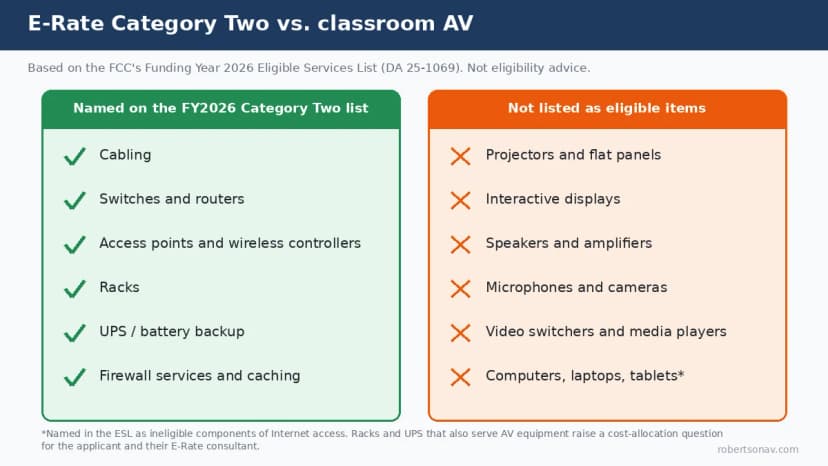
The FCC’s Wireline Competition Bureau adopted the Funding Year 2026 list in Order DA 25-1069, released December 17, 2025. Under “Eligible Broadband Internal Connections,” it lists:
- Antennas, connectors and related components used for internal broadband connections
- Cabling
- Caching
- Firewall services and components (separate from basic firewall protection included with Internet access)
- Racks
- Routers
- Switches
- Uninterruptible power supply (UPS)/battery backup
- Access points used in a LAN or WLAN
- Wireless controller systems
- Software supporting these components
Every item on that list exists to move data. That’s the test to keep in mind.
What isn’t on it
Projectors, flat panels, interactive displays, speakers, amplifiers, microphones, cameras, video switchers and media players aren’t listed as eligible items on the FY2026 list. The ESL also names end-user devices and equipment such as computers, laptops and tablets as examples of ineligible components of Internet access service. In practice, the classroom AV system itself is a budget item for your district, not an E-Rate request.
Racks and UPS: where AV and network overlap
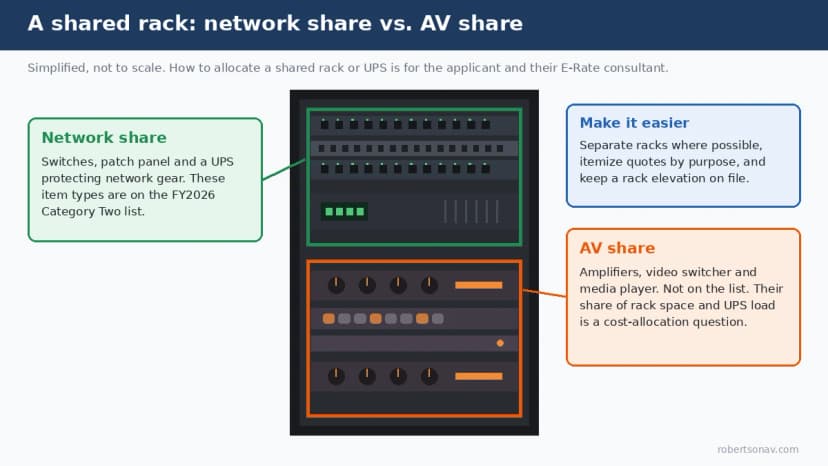
Racks and UPS are eligible because they house and protect eligible network equipment. Many schools, though, put a switch, a patch panel, an amplifier and a video matrix in the same rack, or plug AV gear into the same battery backup as the network. That’s where cost allocation comes in.
When an E-Rate request includes something that serves ineligible purposes, the applicant generally has to remove (cost-allocate) the ineligible share from the funding request. How to divide a shared rack or UPS is a question for the applicant and their E-Rate consultant, not for an equipment seller. The FY2026 order also notes that the FCC declined to change cost-allocation requirements, including for UPS devices, because the issue is under consideration in another proceeding (DA 25-1069, paragraph 12). Expect the guidance to evolve and check the list for the year you’re filing.
Practical steps that make the conversation easier:
- Keep network and AV in separate racks where you can. A rack holding only switches and patch panels is a cleaner request than a mixed one.
- Size UPS units by load. Know which devices each UPS protects, so the network share and the AV share can be shown separately.
- Itemize quotes by purpose. List AV racks, rack shelves, power distribution and AV-only battery backup as separate lines from network infrastructure.
- Document the closet. A simple rack elevation showing what’s mounted where helps your consultant and your auditors.
How E-Rate purchasing works, in brief
E-Rate has its own procurement steps, separate from a normal school purchase:
- Competitive bidding (FCC Form 470). The applicant certifies an FCC Form 470 in the E-Rate Productivity Center describing the services and equipment it wants. USAC’s competitive bidding guidance says applicants must wait at least 28 days after certifying the form before closing bidding, and that the price of eligible equipment and services must get the most weight when bids are evaluated.
- Applying for discounts (FCC Form 471). After selecting a provider, the applicant files the Form 471 during the application window. USAC covers this in Step 4: Apply for Discounts.
- Service provider ID. Vendors in E-Rate need a Service Provider Identification Number (SPIN), also called a 498 ID. USAC explains that it’s a nine-digit number assigned when a provider files FCC Form 498, and that service providers need at least one to participate.
Eligibility changes from year to year. The FCC’s E-Rate page shows the Bureau sought comment on a proposed Funding Year 2027 list in June 2026, so confirm against the final list for your filing year.
Other ways schools fund classroom AV
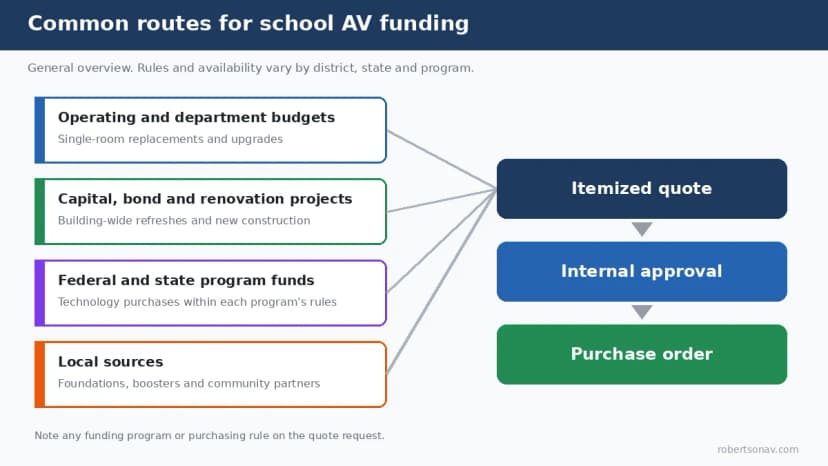
Because the AV system usually falls outside E-Rate, it typically comes from other routes:
Operating and department budgets
Single-room replacements, lamp-to-laser upgrades and failed displays are often bought from building, department or IT operating budgets. A standard room package with consistent models makes these repeat buys predictable. Our guide to ultra-short-throw projectors vs flat panels for classrooms can help you set that standard.
Capital, bond and renovation projects
Building-wide refreshes and new construction often run through capital plans. These projects reward early planning: AV rooms need power, data drops and conduit that are cheaper to add during construction than after.
Federal and state program funds
Some federal formula funds allow limited technology purchases under their own rules. For example, under Title IV, Part A of ESEA, a district may not use more than 15 percent of its funds for the effective use of technology on technology infrastructure purchases such as devices and equipment. Rules, allocations and allowable uses vary by program and state, so check with your federal programs office before tying an AV purchase to a grant.
Local sources
Education foundations, booster groups and community partners sometimes fund specific spaces such as auditoriums, gyms or media centers. Their approval cycles are usually simpler, but they still need an itemized quote.
Buying AV with a purchase order
Whatever the funding source, most schools buy AV the same way: an itemized quote, internal approval, then a purchase order. RobertsonAV quotes are written so you can attach them to requisitions, board approvals and funding applications. Send us the room count, room types and delivery window through our quote request page, and see how to request an AV quote that gets approved for what to include. If a funding program or purchasing rule applies, note it on the request.
Once you have a formal quote, email your PO to orders@robertsonav.com and reference your quote. Our guide to buying AV equipment with a purchase order walks through the process. Net terms are available for eligible partners. Shipping is free on all RobertsonAV orders within the United States, including oversized and heavy items. Some items need a scheduled delivery, and the carrier will contact you to arrange a window; mention any liftgate or inside-delivery needs on your quote request. Orders shipped outside Florida aren’t charged sales tax, and tax-exempt Florida buyers can submit their exemption certificate by logging in to their RobertsonAV account.
FAQ
Does E-Rate pay for classroom projectors or displays?
Projectors and displays aren’t listed as eligible items on the FY2026 eligible services list. The list covers broadband internal connections such as cabling, switches, access points, racks and UPS.
Are equipment racks E-Rate eligible?
Racks are on the FY2026 Category Two list as broadband internal connections. A rack that holds AV equipment, alone or alongside network gear, raises a cost-allocation question to work through with your E-Rate consultant.
Can a UPS for AV equipment be funded through E-Rate?
UPS/battery backup is on the list for eligible network equipment. Protection for AV gear is a cost-allocation matter, and the FCC has said UPS cost allocation is under consideration in another proceeding.
What is a SPIN?
A Service Provider Identification Number, also called a 498 ID, is a nine-digit number USAC assigns to a service provider that files FCC Form 498. Providers need one to participate in E-Rate.
What’s the best way to fund a classroom AV refresh?
Usually a mix: operating budgets for single rooms, capital or bond funds for building-wide projects, and program funds where their rules allow. In each case, start with an itemized quote you can attach to the approval.