
Robertson AV Guides
Classroom Audio: Voice Lift and Soundfield Systems
By Robertson AV ·
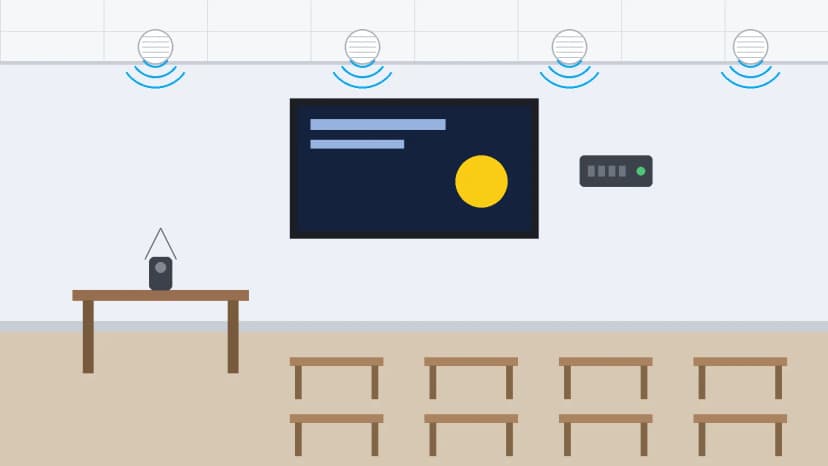
A teacher’s voice is the most important audio source in any classroom, and it’s easy to leave to chance. The front row hears fine. The back row hears the HVAC unit, the hallway and the student next to them. A classroom audio system fixes that by picking up the teacher with a wireless microphone and spreading their voice evenly through the room at a comfortable level. This guide explains how soundfield and voice lift systems work, how they differ from assistive listening, and what to plan before you order for a room, a building or a district.
Why teacher-voice amplification matters
The American Speech-Language-Hearing Association (ASHA) names two causes of poor classroom acoustics: too much background noise and too much reverberation. Noise comes from outside the building, from the hallway and from the room itself, including air handlers and the students. Reverberation is sound bouncing off hard walls, desks and ceilings and lingering in the room.
ASHA links poor acoustics to problems with how students understand speech, pay attention and concentrate, and notes that talking in a loud classroom strains the teacher’s voice. It also points out that a quiet room matters most for students with hearing loss, ear infections, learning disabilities, auditory processing disorder, language delays or attention problems. In most classrooms you won’t know who those students are on any given day, which is the practical argument for treating the whole room.
Amplification is not a substitute for fixing the room. ASHA’s own suggestions are simple: rugs, curtains, soft wall materials, and turning off noisy equipment. The Acoustical Society of America publishes classroom acoustics resources, including guidance tied to the ANSI/ASA S12.60 classroom acoustics standard, which is worth sharing with your architect or facilities team on new builds and renovations. Treat the room first, then amplify.
Soundfield, voice lift and assistive listening: what’s the difference
These three terms get used interchangeably on spec sheets and in purchase requests. They solve related but different problems.
- Soundfield (classroom audio distribution). The teacher wears a wireless microphone, usually a pendant or lanyard style. A receiver-amplifier sends their voice to several speakers spread around the room, so the level is about the same at every seat. The goal is a voice that sits slightly above the room noise everywhere, not a loud PA.
- Voice lift. A form of speech reinforcement used in larger rooms such as lecture halls, training rooms and large meeting spaces. Microphones (worn, handheld or ceiling-mounted) feed a processor that reinforces talkers just enough for the back of the room to hear naturally. Done well, people don’t notice it’s on.
- Assistive listening. A system that delivers audio directly to individual listeners who need it, through personal receivers with earphones or neckloops, or through a hearing loop. It serves specific people rather than the whole room.
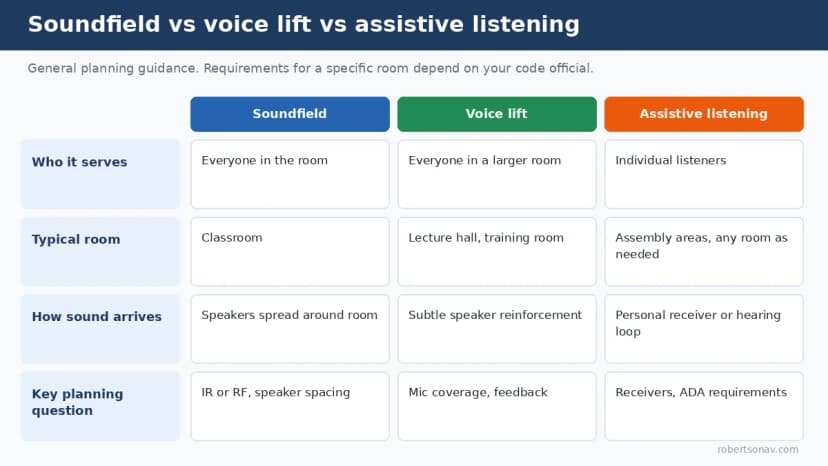
Assistive listening also carries code requirements in some spaces. The 2010 ADA Standards for Accessible Design state that in each assembly area where audible communication is integral to the use of the space, an assistive listening system shall be provided, with an exception where no audio amplification is provided. Whether a given lecture hall, auditorium or multipurpose room counts as an assembly area is a question for your facilities team or code official, so raise it early when you add amplification to a large room.
How a classroom soundfield system works
A typical classroom system has four parts:
- The teacher microphone. Pendant and lanyard mics are common because they stay a consistent distance from the mouth. Headset mics give more gain before feedback but some teachers won’t wear them all day.
- A second microphone for students. A handheld “pass-around” mic lets students answer questions or present so the whole room, and anyone listening remotely, can hear them.
- The receiver-amplifier. It receives the wireless mics, mixes in other sources such as the display or teaching computer, and drives the speakers. Many classroom amplifiers have an auxiliary input for that source audio.
- The speakers. Usually two to four ceiling or wall speakers spaced to cover the seating area evenly.
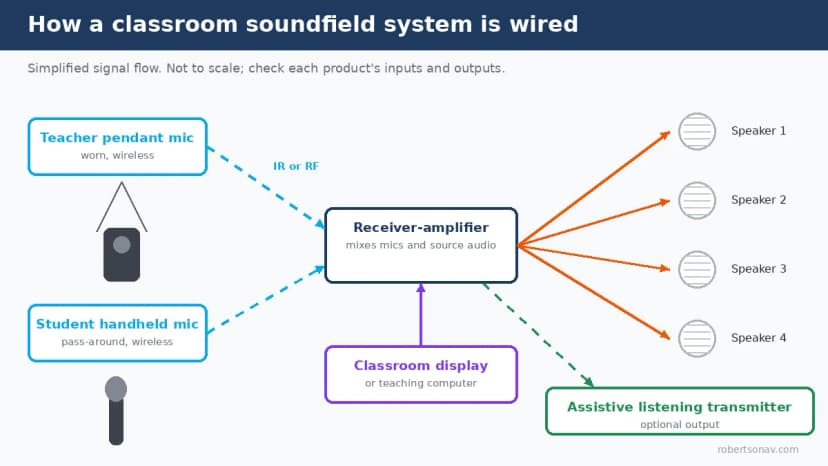
If you’re already planning a new classroom display or a wireless presentation system, decide where video audio goes at the same time. Routing it into the soundfield amplifier means a video plays through the same evenly spaced speakers as the teacher’s voice, instead of through small display speakers aimed at the front row.
Infrared vs RF wireless microphones
Classroom microphone systems usually transmit by infrared (IR) light or by radio frequency (RF). The choice affects how you plan neighboring rooms.
- Infrared stays inside the room because light doesn’t pass through walls. Adjacent classrooms can run identical systems without interfering with each other. The trade-off is that the room needs sensors placed so the microphone’s signal reaches them, and coverage depends on those sensors.
- RF passes through walls and is easier to cover a room with, but neighboring rooms need different channels or frequencies, and a building-wide rollout should include a channel plan. Check each product’s operating band and channel count against the number of rooms on a corridor.
Either can work. What matters is that whoever designs the building layout knows which one you’re using before the first room goes in.
Speaker placement and getting the level right
The point of a soundfield system is evenness. A few rules of thumb:
- Spread the speakers out. Distribute ceiling speakers over the seating area rather than clustering them at the front. In drop-ceiling rooms, lay-in ceiling speakers make this straightforward.
- Keep the mic out of the speakers’ path. Feedback happens when the microphone picks up its own amplified sound. Even coverage at modest levels is less prone to feedback than a few loud speakers.
- Set the level modestly. The teacher should sound clear at the back, not loud at the front. Walk the room while someone talks at a normal level and adjust from the back row.
- Plan for batteries. Wireless mics that die at 11 AM don’t get used. Give each room a charging spot and make charging part of the end-of-day routine.
Our guide to ceiling vs table microphones for meeting rooms covers the same coverage and feedback trade-offs from the conferencing side, which is useful for voice lift in training rooms and boardrooms.
Planning checklist before you order
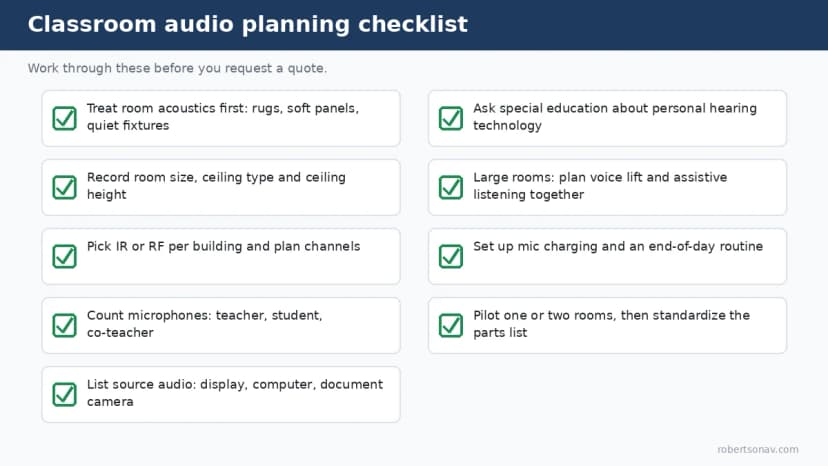
- Room survey. Note the room size, ceiling type and height, and the obvious noise sources. Fix what you can (rugs, soft panels, noisy fixtures) before you specify amplification.
- Microphones. One teacher mic per room is the minimum. Add a student handheld if students present or answer aloud often, or a second worn mic for co-taught rooms.
- IR or RF. Decide per building, not per room, so neighboring rooms don’t conflict.
- Source audio. List every source the system should carry: display, teaching computer, document camera, wireless presentation receiver.
- Individual needs. Ask your special education team whether any students use personal hearing technology. Some systems can feed an assistive listening transmitter or a student’s personal receiver; confirm compatibility on the spec sheet.
- Large rooms. For lecture halls and auditoriums, plan voice lift and assistive listening together, and check with your facilities team about ADA assembly-area requirements.
- Pilot first. Install one or two rooms, gather teacher feedback for a few weeks, then standardize the parts list for the district order.
Getting quotes and ordering
Browse our assistive listening, amplifiers and ceiling and in-wall speakers categories, or send us your room count, room sizes, ceiling type, IR or RF preference and source list through our quote request page. Our guide on how to request an AV quote that gets approved covers what to include. Shipping is free on all RobertsonAV orders within the United States, including oversized and heavy items. Schools can buy with a purchase order against a formal quote: email the PO to orders@robertsonav.com and reference your quote. Net terms are available for eligible partners. Orders shipped outside Florida aren’t charged sales tax, and tax-exempt Florida buyers can submit their exemption certificate by logging in to their RobertsonAV account.
FAQ
What is a classroom soundfield system?
It’s a wireless microphone for the teacher, a receiver-amplifier and several speakers spread around the room. It raises the teacher’s voice slightly above the room noise so every seat hears it at about the same level.
What’s the difference between voice lift and a soundfield system?
Both reinforce speech for a whole room. “Soundfield” usually describes classroom systems built around a worn teacher mic. “Voice lift” usually describes subtle speech reinforcement in larger spaces like lecture halls and training rooms, often with ceiling or multiple microphones.
Is a soundfield system the same as assistive listening?
No. A soundfield system serves everyone in the room through speakers. Assistive listening delivers sound to individual listeners through personal receivers or a hearing loop. Some rooms need both.
Should we choose infrared or RF microphones?
Infrared stays inside the room, so neighboring classrooms don’t interfere, but it needs sensors with coverage of the teaching area. RF covers a room easily but needs a channel plan for adjacent rooms. Pick one approach per building.
Can the system play audio from our classroom display?
Usually, yes. Many classroom amplifiers have an auxiliary input for the display or teaching computer, so videos play through the same speakers as the teacher’s voice. Check the input types on the spec sheet against your display’s audio output.