
Robertson AV Guides
Choosing PA Speakers for Gyms and Multipurpose Rooms
By Robertson AV ·
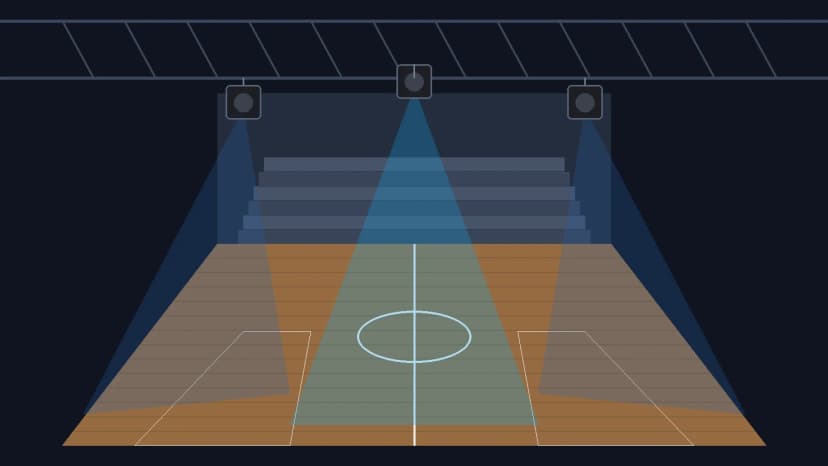
Gyms are where good PA systems go to die. Hard floors, block walls, steel roof decks and folded bleachers turn every announcement into a wash of echo, and the usual fix, turning it up, only makes it worse. Choosing PA speakers for gyms and multipurpose rooms is less about raw wattage and more about putting the right kind of speaker in the right place, aimed at people instead of walls. This guide walks through how coverage and intelligibility work in large rooms, the two common layouts, and how to size amplifiers so the system lasts.
Why gyms are so hard on speech
Reverberation sets the ceiling
Reverberation time (RT) is how long sound takes to decay after the source stops. A Walls & Ceilings article on multipurpose spaces notes that published literature puts the range for good speech intelligibility in classrooms and lecture halls at 0.6 to 2.0 seconds, while a gym used mainly for sports can live with 2.0 to 3.0 seconds. The same article makes the point every integrator learns the hard way: in a room that is too reverberant, raising the volume adds acoustic energy to the decay rather than shortening it, so the talker gets louder but no clearer.
That has two practical consequences. First, if the gym also hosts assemblies, graduations or community meetings, acoustic treatment on walls or the roof deck may do more for intelligibility than any speaker upgrade. Second, the speaker system should be designed to put as little energy as possible onto reflective surfaces.
Distance works against you
Outdoors, or in any free field, level from a point source drops about 6 dB each time the distance doubles. JBL’s Sound System Design Reference Manual explains why: at twice the distance, the same power is spread over a sphere with four times the area. Yamaha’s tutorial on the 6 dB per doubling rule walks through the same math as 20 log of the distance ratio.

Indoors the rule breaks down as you move away from the speaker, because reflected sound starts to dominate. That is exactly the problem: the farther a listener is from the speaker, the larger the share of what they hear is echo rather than direct sound. One large box at the end of the gym leaves the far bleachers several doublings away and listening mostly to the room.
Coverage strategies that work
Get speakers close and aim them at people
In an Athletic Business piece on sound in high school gyms, the integrators interviewed keep coming back to the same rules: get speakers as close to listeners as you can, avoid firing sound into rafters and floors, and resist the urge to line each wall with speakers, which creates its own reflections. They also point out that announcements coming from behind the crowd make people strain to listen, so speakers should generally face the audience from the direction of the action.
Two common layouts
Biamp’s basketball gymnasium design template shows two approaches for a typical 120 ft by 100 ft high school gym with 28 ft to the bottom of the trusses and bleachers up to 14 ft tall:
- General coverage. Bleacher speakers mounted about 20 ft in front of the first row and aimed at the seats, plus court speakers mounted at a single point above center court.
- Distributed court coverage. The same bleacher speakers, with down-firing speakers spread across the court instead of one central position. Biamp describes this as giving better speech intelligibility on the floor and more zone control for multipurpose events.
The template also notes that bleachers longer than 70 ft can need four or more speakers per side.

Zoning for multipurpose use
A multipurpose gym rarely fills every seat. The Athletic Business article describes turning off speakers that cover empty sections, such as upper seating with delay fills, because less energy hitting empty seats means less reverberation for everyone else. Plan zones that match how the room is actually used: home and visitor bleachers, the court floor, a stage end for assemblies, and any lobby or concourse fill.
Choosing the speakers
Pattern control matters more than size
For speech in a reflective room, look for speakers with controlled, published coverage angles, typically horn-loaded or constant-directivity designs. Biamp’s template, for example, specifies horn-loaded two-way and coaxial models with defined horizontal and vertical patterns, such as 90 by 40 or 60 by 60 degrees, so the sound can be pointed at the bleachers and kept off the walls. Steerable column arrays are another option in very reverberant rooms because they put sound into a tall, narrow pattern.
When comparing models, check the published coverage pattern, frequency range, sensitivity and maximum output, and whether the speaker offers 70V transformer taps or low-impedance operation.
How loud is loud enough
One integrator in the Athletic Business article aims for about 6 to 10 dB above crowd noise and wants the system to top out around 90 to 95 dB for these venues, while still having more capability than it normally uses so components are not driven at full output every game. Treat that as one experienced designer’s target, not a standard, and confirm targets with your own measurements or modeling.
Subwoofers, used carefully
Low-frequency support helps music for pep rallies and halftime, but bass is the hardest part of the spectrum to control in a reverberant gym. If speech is the priority, start with full-range speakers that have good pattern control and add subwoofers only where music playback is a real requirement.
Amplifiers and 70V lines
Many gym and multipurpose systems run speakers on a 70V distributed line, especially for bleacher, lobby and concourse zones. JBL’s Distributed Speaker Systems 101 explains that the designer simply adds up the transformer taps, and recommends keeping that total below 80% of the amplifier’s rating. Lowell’s guide to 25V, 70V and 100V systems gives the same two rules: the tap total must never exceed the amplifier rating, and about 80% loading is better practice because the amplifier runs cooler and you keep room to add a speaker or raise a tap later.
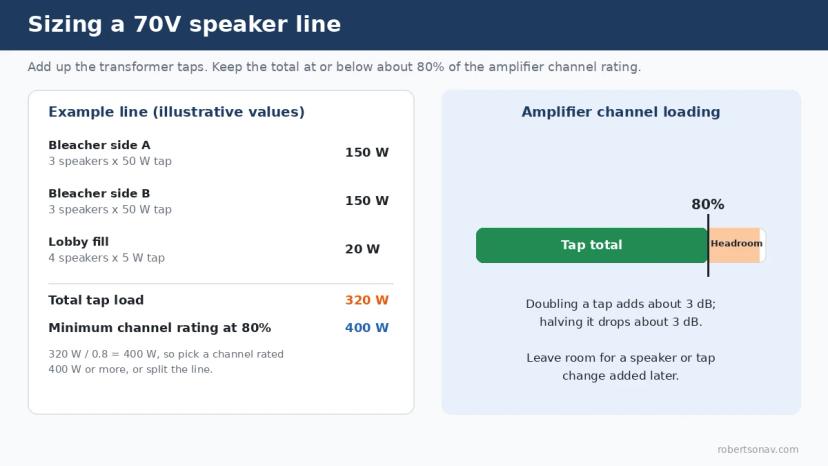
Taps are also your level control. Peavey’s constant voltage distribution paper notes that each doubling or halving of a tap changes level by about 3 dB. Use that to balance a near zone against a far one before reaching for EQ.
Larger systems often pair speakers with a DSP amplifier or loudspeaker controller that adds manufacturer presets, limiting, zone routing and remote monitoring.
Microphones, feedback and accessibility
Feedback is a placement problem first. Keep speakers aimed away from where wireless microphones will be used, such as the scorer’s table and stage end, and use DSP feedback suppression as a backstop rather than the fix. Our guide to ceiling vs table microphones covers pickup patterns that apply here too.
Don’t forget assistive listening. The 2010 ADA Standards, section 219 in the U.S. Access Board’s ADA guide, require an assistive listening system in each assembly area where audible communication is integral to the use of the space, with an exception (other than courtrooms) where audio amplification is not provided. Confirm with your facilities team or code official how that applies to your gym, and see our assistive listening systems.
A planning checklist
- Measure the room: length, width, height to the low steel, bleacher size and seating positions.
- List every use: games, assemblies, graduations, community events, fitness classes.
- Decide whether acoustic treatment belongs in the budget alongside speakers.
- Choose a layout: bleacher coverage plus central or distributed court speakers, with zones that match real attendance.
- Pick speakers by coverage pattern and output, then add up taps and size amplifiers at about 80% loading.
- Plan microphone positions, feedback control and assistive listening.
- Have the design modeled or reviewed before ordering.
Planning a smaller room on the same campus? Our guide to classroom voice lift and soundfield systems covers classroom audio, and classroom display planning covers the visuals.
FAQ
What type of speaker is best for a gymnasium?
For speech, speakers with controlled coverage patterns, such as horn-loaded or constant-directivity designs, aimed at the seating areas. Steerable column arrays can help in very reverberant gyms.
Should gym speakers be in the center or along the walls?
Both approaches are used. Biamp’s template aims bleacher speakers at the seats from in front of the first row and covers the court either from a single center position or with distributed down-firing speakers. Lining the walls with many speakers tends to add reflections.
Will a bigger amplifier make announcements clearer?
Usually not. In a reverberant room, more level also means more echo. Speaker placement, pattern control and room treatment improve intelligibility; amplifier headroom keeps the system from clipping.
How do I size an amplifier for 70V gym speakers?
Add up every speaker’s tap setting on the line and choose an amplifier channel rated so that total is about 80% of its output or less.
Can RobertsonAV quote a complete gym sound package?
Yes. Send room dimensions, seating layout, how the room is used and any existing equipment through a quote request, or browse our speakers and amplifiers. Shipping is free on all RobertsonAV orders within the United States, including oversized and heavy items. Some items need a scheduled delivery, and the carrier will contact you to arrange a delivery window. If you need liftgate or inside delivery, mention it on your quote request. Our guides to requesting an AV quote that gets approved and buying AV equipment with a purchase order explain the rest of the process.