
Robertson AV Guides
Outdoor and High-Brightness Displays: What to Know
By Robertson AV ·

A lobby display that looks fine under office lighting will wash out in a sunlit storefront, and a consumer television is the wrong tool for either job. Outdoor and high-brightness displays are specified for ambient light, weather and heat — not just screen size. This guide covers what nits measure, why contrast and glass matter as much as the brightness number, how ingress and impact ratings work, and what to put on a quote so the panel matches the site you have.
If you are still choosing a commercial panel rather than a consumer TV, start with our commercial display vs consumer TV buyer's checklist. Size still follows viewing distance; see commercial display sizes: 55 vs 65 vs 75 vs 86 inch once you know how far the audience stands.
What a nit measures — and what it does not
Display brightness is specified in nits. One nit equals one candela per square meter (cd/m²), the luminance of the screen surface. A higher rating means the panel can produce more light, which matters outdoors because daylight and reflections shrink the apparent contrast between the image and everything around it.
The published figure is not the whole story. Manufacturers may quote typical, minimum or peak luminance, and a bare module rating can be higher than what a viewer sees through cover glass. Coatings, optical bonding, haze and the angle of the sun all change readability. When you compare datasheets, confirm whether the number is typical or peak, and whether it is measured on the finished display. Brightness also has to be controllable: a panel that is readable at noon can be harsh after dark. Purpose-built outdoor and high-brightness models commonly include an ambient-light sensor that raises and lowers output automatically.
Indoor, window-facing, and true outdoor are different products
Treat the environment as a design input, not a marketing label.
- Standard indoor commercial displays are built for controlled interiors: lobbies, conference rooms, classrooms. They are the right starting point when sunlight does not strike the screen.
- High-brightness and window-facing displays are aimed at atriums, storefronts and other spaces where daylight or a bright window sits behind or on the glass. They need enough luminance and reflection control to stay readable, but they may not be sealed for rain, dust or freeze-thaw cycles.
- Purpose-built outdoor displays combine high luminance with an environmental enclosure: ingress protection, impact-rated glass, thermal management and an operating-temperature range that matches the climate.
Placing an indoor panel in a third-party enclosure can be a valid path for some sites, but it is a system design, not a shortcut. The enclosure must handle heat, moisture, dust, service access and the panel's airflow. Do not assume a high-nit indoor panel is weatherproof.
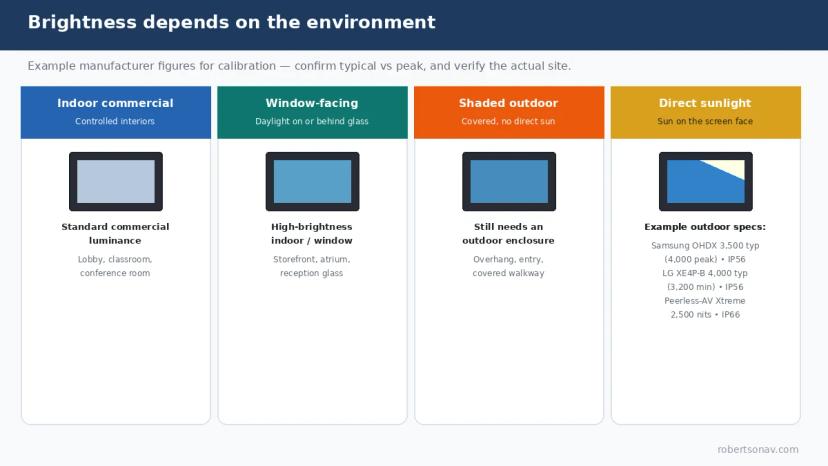
There is no single industry brightness that fits every site, and we will not invent one. As reference points, current outdoor models from major manufacturers are specified in the mid-thousands of nits: Samsung's OHDX-class outdoor signage at 3,500 nits typical (4,000 nits peak), LG's XE4P-B at 4,000 nits typical (3,200 nits minimum), and Peerless-AV's Xtreme High Bright line at 2,500 nits. Use those published figures to calibrate a spec, then confirm the sun path, orientation and reflections on your wall. Full datasheet notes on duty cycle, sensors and glass are in the FAQ below and in the image credits.
Contrast, glass, and optical bonding
Sunlight raises the ambient light the image has to beat, and it bounces off the front glass as glare. A bright panel with untreated glass can still be unreadable if the viewer sees the sky or a parked car in the reflection. Look for anti-reflective or anti-glare treatments, and ask whether the cover glass is optically bonded to the panel — bonding fills the air gap that otherwise creates internal reflections. Haze, viewing angle and portrait-versus-landscape qualification belong on the comparison sheet before you design the mount.
IP and IK ratings are not interchangeable
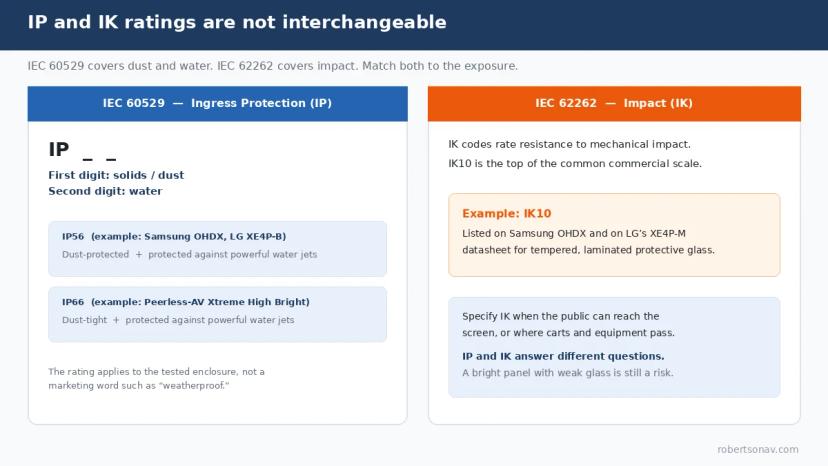
Ingress protection is defined by IEC 60529. The first digit describes protection against solid objects and dust; the second describes protection against water. The rating applies to the enclosure as tested, not to a marketing phrase such as "weatherproof."
On current outdoor signage, IP56 appears on both the Samsung OHDX series and the LG XE4P-B: dust-protected, and protected against powerful water jets. Peerless-AV specifies IP66 on the Xtreme High Bright line: dust-tight, with protection against powerful jets. Those are not the same rating. Match the IP level to the exposure — a covered overhang is not a shoreline kiosk — and do not substitute a higher brightness number for a weaker enclosure.
Impact protection is a separate scale, IEC 62262 (IK codes). IK10 is the top of the common commercial scale and is listed on the Samsung OHDX series and on LG's XE4P-M datasheet for tempered, laminated protective glass. If the display can be reached by the public, or sits where carts and equipment pass, the glass rating belongs in the specification alongside IP.
Heat is as likely to fail a display as rain
High-brightness backlights produce heat, and a sealed outdoor chassis has to shed it without pulling in rain or dust. Check the published operating-temperature range, thermal design, and whether the unit will start from a cold soak. Peerless-AV, for example, rates the Xtreme High Bright line from −35 °C to 60 °C (−31 °F to 140 °F). Outdoor and window-facing products are often specified for 24/7 operation; a standard indoor panel may not be. Confirm hours-per-day, whether an auto-brightness sensor is included, and how the unit is serviced.
Signal, playback, and mounting
An outdoor display still needs a source. Some chassis include a built-in player; others want an external player in a conditioned space. For player and CMS choices, see digital signage software and media players explained. Long runs may need an extender; our guide to HDMI over HDBaseT covers when copper HDMI is no longer enough. If the facade is a tiled canvas, plan it as a video wall, not as a brighter TV. Mounts must be rated for the outdoor chassis weight, wind load and orientation. Browse televisions and monitors, digital signage and mounts after the environment and luminance are locked.
A practical specification checklist

- Describe the site: indoor, window-facing, shaded outdoor, or direct sun, including compass orientation and whether sunlight hits the face of the screen.
- State a luminance target as typical nits, and ask whether the figure is typical or peak and measured on the finished display.
- Require the cover-glass treatment and whether the panel is optically bonded.
- Specify an IEC 60529 IP rating and, if the public can reach the screen, an IEC 62262 IK rating.
- Record the published operating-temperature range, duty cycle, and whether an ambient-light sensor is included.
- Lock portrait or landscape, mount type, and the structural surface.
- Define the source: built-in or external player, signal path, and where the electronics will live.
- Note delivery constraints. Large-format displays ship by freight on a pallet, typically curbside, and the carrier schedules a delivery window. If you need liftgate or inside delivery, say so on the quote request.
FAQ
Can I put a consumer TV in an outdoor enclosure?
That is almost always the wrong starting point. Consumer televisions are not designed for the luminance, duty cycle, thermal path or enclosure a sunlit or weather-exposed site requires. Use a commercial or purpose-built outdoor display, and read the commercial versus consumer checklist before you shop by screen size alone.
How many nits do I need for direct sunlight?
It depends on the sun path, reflections, glass and content contrast, so there is no single correct number. Use published outdoor models as a calibration point: Samsung lists 3,500 nits typical (4,000 nits peak) on its OHDX-class outdoor signage, LG lists 4,000 nits typical (3,200 nits minimum) on the XE4P-B, and Peerless-AV lists 2,500 nits on the Xtreme High Bright line. Then verify readability at the actual site, including late-afternoon glare.
Is a high-brightness indoor display the same as an outdoor display?
No. High luminance helps a window-facing or atrium install, but outdoor duty adds ingress protection, impact-rated glass, a qualified operating-temperature range and a thermal system designed for a sealed chassis. Specify those items separately.
What do IP56 and IP66 actually mean?
Both are IEC 60529 enclosure ratings. IP56 is dust-protected and protected against powerful water jets; IP66 is dust-tight and protected against powerful water jets. Match the rating to exposure, and treat the manufacturer's stated rating as applying to the tested assembly.
Do outdoor displays need a media player?
They need a source. Some outdoor chassis include a built-in player; others are fed from an external player in a conditioned space. Choose the architecture first, then the player, as outlined in our media players guide.
Can RobertsonAV quote a high-brightness or outdoor display?
Yes. Send the site type (indoor, window-facing or outdoor), sun exposure, size, orientation, mounting surface, and any playback or control needs through a quote request. Shipping is free on all RobertsonAV orders within the United States, including oversized and heavy items. Large-format displays ship by freight on a pallet, typically curbside, and the carrier schedules a delivery window. If you need liftgate or inside delivery, mention it on your quote request. Orders outside Florida have no sales tax; Florida orders are taxed unless you submit a tax-exemption certificate by logging into your RobertsonAV account. Net terms are available for eligible partners. Purchase orders are accepted against a formal quote and should be emailed to orders@robertsonav.com with a reference to your quote.